An action plan is a detailed plan outlining actions needed to reach one or more goals.
Use an Action Plan whenever you need to plan a small project.
To draw one up, simply list the tasks that you need to carry out to achieve your objective, in the order that you need to complete them. (Mindtools, 2021)
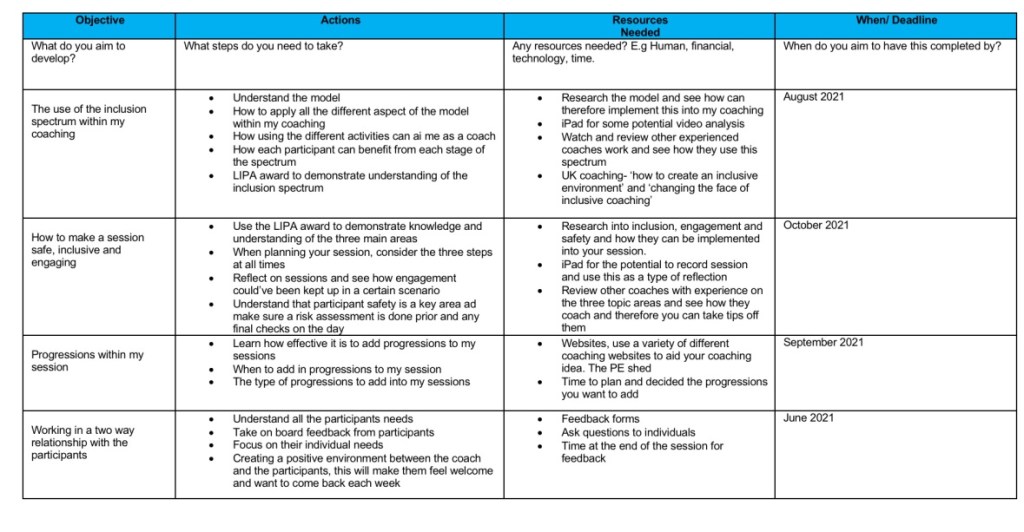
I have set out an action plan of goals an objectives I want to achieve or try and work towards to make myself a better overall coach.
This is the action plan, it outlines what the objective is, what steps I need to take to fulfil the objective, what resources I need to complete to objective and the deadline date for the objective.
Health and safety is the regulations and procedures intended to prevent accident or injury in workplaces or public environments.
A risk assessment is the technique by which you calculate the chances of an accident happening (Honeybourne, 2005). Preventative measures can be put into place to reduce the risk of any hazards that will occur, therefore improving the health and safety of the event.
My Views- Negative
What would the parents think?
No basic skills are being developed here
Issues I they fall from the mat
My Views- Positive
The participants see it as a challenge
They love the competitive nature
They won’t care about the potential of falling and hurting themselves
Enjoyment of working in a team
Upon reflection this map flipping session isn’t a reasonable activity to be doing with this age group. This is because the health and safety issues are very high. There is no protective equipment around the mat so if they do fall then they’re hitting a hard sports hall floor. Continuously, the child’s parents are highly likely to be worried about their children participating in this activity due to the safety concerns identified. Furthermore, this wouldn’t benefit a child’s skill set they need to be developing at such a young age. The child’s FUNdamentals of movement skills must be developed at this age as it is the ‘window of opportunity’ for physical literacy (Stafford, 2005). Balyi, Way & Higgs (2013) stated that FUNdamental movement skills are not taught or taught incorrectly, children may lose options for participating in sport and physical activity which means they have a shorter variety of sports to participate in. This is why doing mat flipping at this age will not benefit their development as they will be missing out on key developmental areas.
Reference List
Balyi, I., Way, R., & Higgs, C. (2013). Long-term athlete development. Human Kinetics
Honeybourne, J. (2005). BTEC First Sport. Cheltenham: Original illustrations.
Stafford, I. (2005). The Long Term Athlete Development. London: Sport England
According to Stoszkowski (2018) ‘Flipgrid is an online video discussion platform, designed to empower learners and facilitate collaboration and social learning between students.’
On the link below there is a flipgrid debate upon the strengths and areas for improvement we think that flipgrid impacts us as a coach.
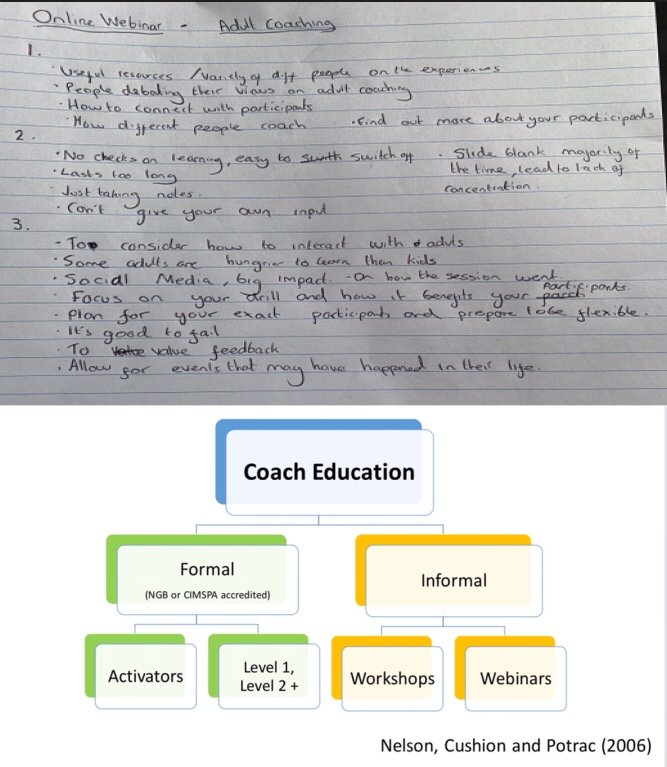
Coach eduction is ‘a key vehicle for raising the standard of coaching practice.’ (Nelson, Cushion & Potrac, 2013) Coach education can be split up into two main categories, formal and informal practices.
Formal coach education
Formal coach education is ran by national governing bodies (NGB) and are split into activator courses and level 1 and level 2+ qualifications. Furthermore, a formal coach education practice is compulsory to attend all parts of the practice and the assessment is based against a set number of minimum competencies. At the end of the practice, if passed, each clients will receive a certificate saying that they have passed and completed the course.
Informal Coach education
Informal coach education is ran outside of the NGB network therefore can be ran by anyone. They can be split into workshops and webinars. The informal practice is self directed and knowledge based and at the end of the practice there can be a knowledge assessment. There is also a certification process to say you have competed the coach education practice.
Below is some feedback from a recent online webinar I took part in for coaching adults. It highlighted what is good about an online webinar, what issues you may face when participating in an online webinar and the knowledge I have gained from it.
Analysing my Coach Education experiences
My various Coach Education practices-
Online Webinar (Adult Coaching)
Equality and Diversity (Informal CE workshop)
FA introduction to Talent ID Level (Informal CE workshop)
Tennis Activators (Formal CE)
Basketball activators (Formal CE)
Baseball activators (Formal CE)
Athletics activators (Formal CE)
The FA player award (Informal CE workshop)
NPLQ (National Pool Lifeguard Qualification) (Formal CE)
Below are some examples of certificates and topic booklets received from these Coach Education practices that I have gained.
Within each variant of a Coach Education practice I feel I prefer the formal Coach Eduction practices. This is due to the practical element being involved within the practices as these get me more engaged and therefore are more likely to benefit me greater as I will benefit more from this. For example, doing the equality and diversity workshop (Informal CE) I feel like this was very beneficial as it opened my eyes to various scenarios that I may not have realised can happen within coaching. However, the fact it was online and just reading and answering questions made me disengage with the course therefore the way I did the course may not have been as beneficial as if it had some practical elements. On the other hand, when I completed the Basketball activators (Formal CE) I feel like this benefitted me in multiple ways as I can use the drills that we was shown as use them in many other sports that I coach myself. The resource booklet we took away can be used in the future in our own coaching as we can use these sessions whenever we like and tailor it to our own coaching and finally the fact that we got to coach a sport that we may not necessarily do on a regular basis can benefit us as we now have a wider range of knowledge in that sport.
Types of CE I want to access in the future
Level 1/2 in Football coaching
A number of new a different activator courses
More online webinars about inclusive coaching/ how to make your coaching better
FA level 2 Talent ID
More FA equality and diversity badges
I would like to complete as many more Coach Education practices as I can as I feel this will enhance my knowledge upon various different platforms within coaching and it will aid boost my CV when applying for a job.
Reference list
Nelson, L., Cushion, C., & Potrac, P. (2013). Enhancing the provision of coach education: The recommendations of UK coaching practitioners. Physical Education and Sport Pedagogy, 18(2), 204-218.
Nelson, L. J., Cushion, C. J., & Potrac, P. (2006). Formal, nonformal and informal coach learning: A holistic conceptualisation. International Journal of Sports Science & Coaching, 1(3), 247-259.
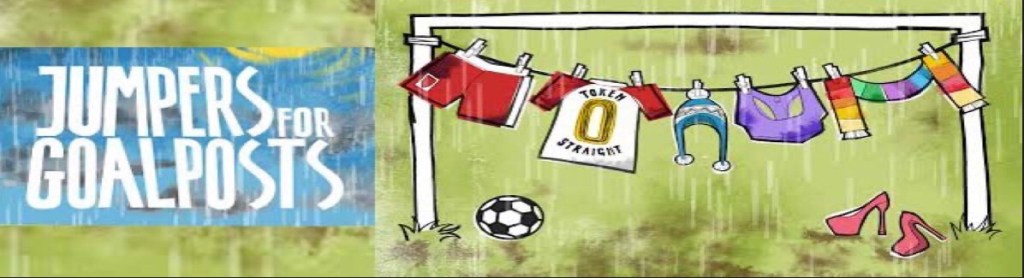
Who would’ve though the ‘Jumpers for goalposts’ saying would come true in the sense of at home PE. This is due to the current COVID 19 situation and the schools being closed and students having to use their own resources to keep active just like when you are on the playground and your school jumper replaces the goalposts.
At home or remote PE is currently taking place due to the current government situation regarding the closure of schools, colleges and universities across the country. The current COVID 19 situation means that PE can not take place in the way it usually would whether it being a full class game of rounders outside or a handball session in the sports hall. This has changed the way PE is done massively with some students potentially missing out on valuable exercise or their only physical exercise that week. PE sessions have changed to either student creating their own at home PE resource or they are participating in a previously designed remote PE resource. I feel like I am in a position to help schools, this is because I may have more knowledge n that specific area than the standard primary school teacher. Furthermore, they also have a lot of other work to be doing therefore PE may be the last thing on their mind. On the other hand, this will benefit as I can create at home resources to provide to schools to use in their lessons. This will benefit me as it will help the to gain experience and valid feedback upon sessions I plan.
Issues with at home PE
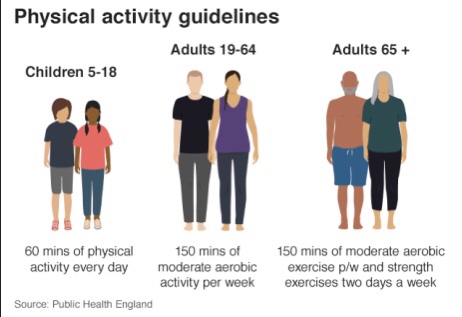
There are many issues with at home PE that can effect a student in many ways. Whether this be a decline in their fitness or a decline in their mental health as a results of a lack of exercise. As stated by Therrien (2018) there is a guide to the duration of physical activity people should do per week depending upon their age. The image below shows the physical activity guidelines for the different ages. As shown by the image children aged between 5-18 should have at least 60 minutes of exercise everyday. With the home PE the children wont be able to fulfil this guideline which may lead to an increase in child obesity and also it may lead to a high drop out rate due to a loss of interest during this period
Furthermore, many students may find at home PE boring or disengaging as they’d much rather be doing other thing than doing their PE session at home. This may be due to a lack of concentration as different ages of children can only concrete for so long. According to Brain Balance (2020) the table below shows the average attention span for children up to 16 years old.
Average attention spans work out like this:
2 years old: four to six minutes
4 years old: eight to 12 minutes
6 years old: 12 to 18 minutes
8 years old: 16 to 24 minutes
10 years old: 20 to 30 minutes
12 years old: 24 to 36 minutes
14 years old: 28 to 42 minutes
16 years old: 32 to 48 minutes
Continuously, these figures show that it can be hard to concentrate for lengthy periods of time this is why PE can be an escapee for some students as it will clear their mind of anything that can be bothering them and they are just sat in a chair listening to a teacher in a classroom. As a results of this online PE can be a negative as they won’t get that time to use up their energy they are just sitting in front of their computer and therefore are more likely to lose their focus quicker which may potentially make the session irrelevant.
What does good practice look like?
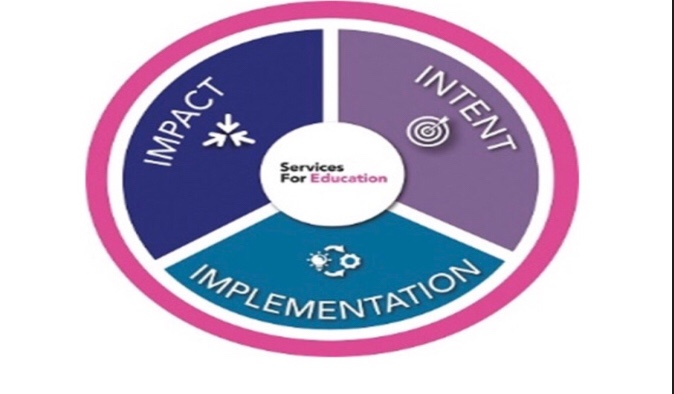
There are three focus points to work on when focussing on what good practice looks like, intent, implement and impact.
Intent- By identifying priorities, focusing on learning and the students you have in front of you and catering it to their specific needs. Consider, why are PE lessons so important? What content you want to deliver? Furthermore, focus on who you are teaching as each participant is unique.
Implementation- Online lessons can sill be very meaningful and have a positive impact on students learning.
Research from the Education Endowment Foundation tells us:
Teaching quality is more important than how the lesson is delivered
Peer interaction can provide motivation and provide better learning outcomes
Ensuring access to the technology is key, especially for the disadvantaged pupils
Impact- The amount of content out there suggests we don’t have to reinvent the wheel to make an impact. This shows that at home PE can have the same benefits as in school PE just because they’re at home on their computer doesn’t mean they can’t have as much fun or learn as much as they would in their practical session.
(Keens, L, 2020)
My at home PE resource
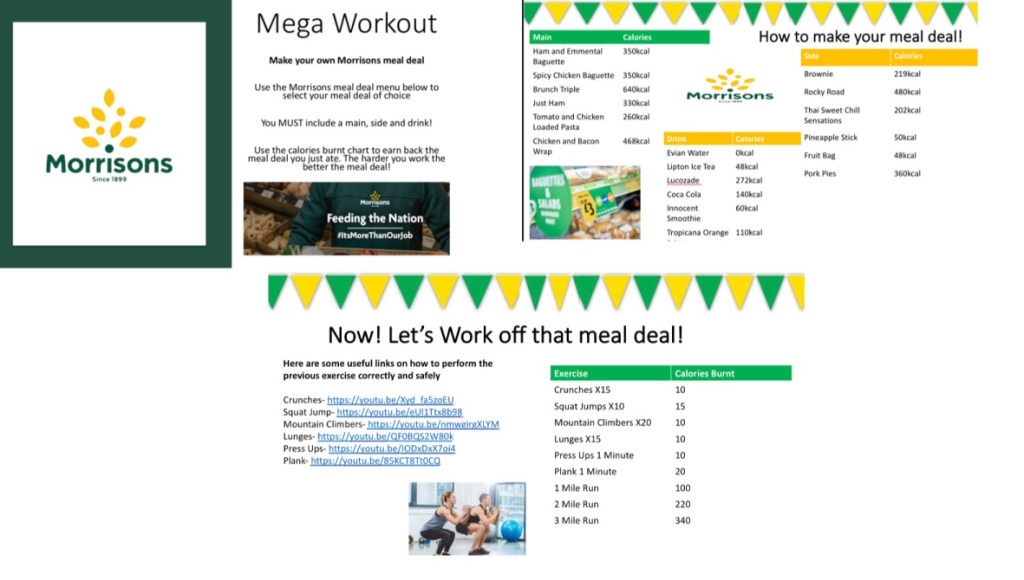
This is an example of an at home PE resource.
The key areas to think about when creating the resource:
A theme (does it suit the participants)
Engaging
Enjoyable activities
Beneficial activities
Health and safety
Accessibility to equipment/resources needed
A variety of exercises, to suit mixed abilities
Links/diagrams of how to perform exercises correctly and safely
Below is my at home PE resource. The theme suits the intended audience. Engaging activities are included as it is building a meal deal and then burning off the chosen calories. Health and safety is considered when planning the resource as there are links on how to perform each exercise effectively and safely. Each activity can suit a variety of abilities and can also benefit the individual participating.
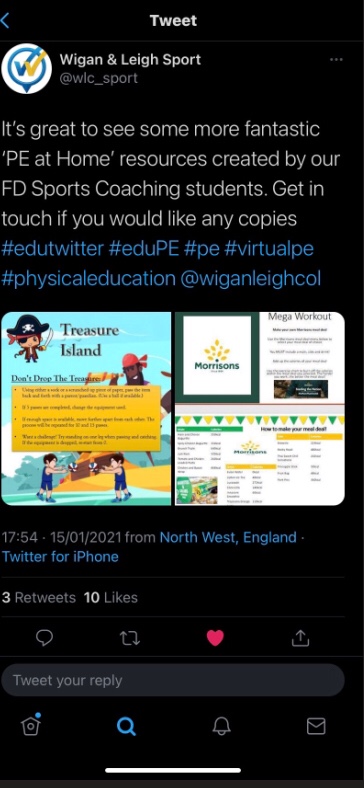
As seen below the at home PE session has been uploaded to the college Twitter account for anyone to use them or participate in them to gain their fitness over lockdown and can be very useful for any online PE sessions. From this experience I learnt that creating an online resource can be extremely difficult, this is because you need to consider, will they have the space to do this activity?, will they have the equipment to do this activity? or do they need assistance when doing the activity? You have to make the activity as inclusive for everyone as possible and understand every child has a different circumstance to their learning environment.
Feedback
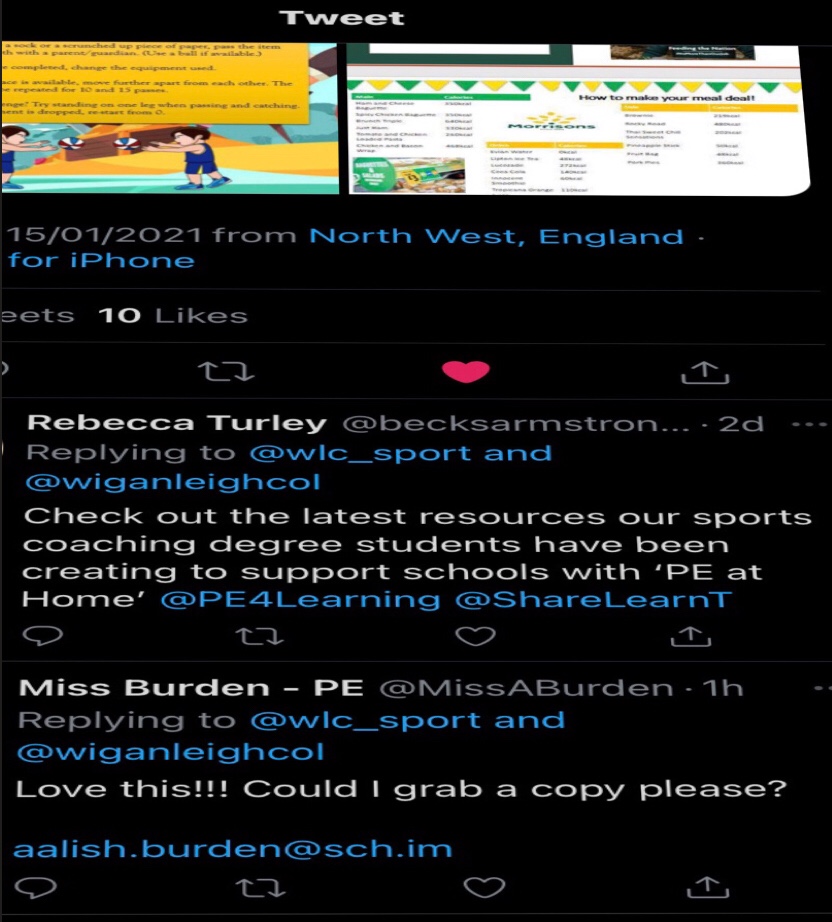
Comments have been made on the post asking can they have a copy of the resources for their students to work on whether this be an example for them to create their own or the students are going to be participating in the at home PE session. From this I have gained some valuable employability skills, such as my planing and delivery of sessions and how different it is from remote sessions to face to face sessions. The planning for remote PE has proved to be more of a challenge as you have to think of the type of activity in more detail as considering peoples working environments can prove to be a challenge as they may not be able to to certain activities you have planned. Furthermore, using various different ICT resources enhances my employability as using apps such as Microsoft word and PowerPoint are widely used across the teaching base now and knowing how to use them gives you an advantage over other people who struggle with ICT resources.
Wilson (2000) defined volunteering as any activity in which time is given freely to benefit another person, group or cause. ‘Volunteering constitutes one of the most important pro‐social activities.’ (Meier & Stutzer, 2008) this is vital as when volunteering it can help you gain more knowledge about the area you what to delve into before you get it as an actual job, so it can be like a trail to see if that is the area you want to progress into.
Benefits to volunteering
There are many different benefits to volunteering whether that be for the volunteer or the club. Argyle (1999) stated that volunteers see results as an important source of satisfaction. This can be a benefit for the individual as it can show that their hard work, time and effort can account for something positive as seeing results will give them the confidence to carry it on in the future. Continuously, research studies show that most people believe that helping others is a good way to gain fulfilment for yourself. This is another benefit for the volunteer as their work is making yourself feel better showing that it is worth being a volunteer just for the personal beliefs and achievements.
I have benefitted from volunteering as it has given me the opportunity to coach in a variety of different environments and coach a wide range of participants giving me more experience every time I coach. The main skills I feel I have developed is my confidence, as I now feel confident to coach any group at any given time and produce a good session. Furthermore, my communication skills have improved as I feel I can communicate in many different ways and do this effectively, I feel like tone of voice is key when coaching the younger age groups as this will get them more engaged and they are more likely to listen.
Challenges a volunteer may faces
On the other hand volunteering can propose many challenges. This many include taking up a lot of time, energy, skills and no pay. (Donnelley & Harvey, 2010) this is a huge challenge as a volunteer must be able to balance their busy life schedule to maintain the standards of being a volunteer and this may apply added pressure to their daily life. Furthermore, according to Hoeber (2010) volunteers efforts go unrecognised or unnoticed. This may make a volunteer unmotivated as all the hard work they have put in may for under the radar and not get thought about, potentially leading to the volunteer quitting the role.
What are my next steps within volunteering
Within the college I currently volunteer by coaching the women’s football team alongside another member of the class, which is discussed below, this placement will aid me to gain more knowledge about coaching in general and give me fresh ideas which I can transfer to other sessions.
Before the start of the year my aim for volunteering/work placement was to go into a school and shadow a PE teacher as this will help me gain the knowledge I need to progress in the career path I want. However, due to the current circumstances I felt like I was unable to enter a school setting as schools will not have allowed visitors in. To continue on, in the next year of my degree I will look to go into a school for my placement and work alongside a PE teacher as I feel this will benefit me as a person and give me that edge when applying for my teacher training qualification in the future.
Women’s football team
The women’s football team is a part of Wigan and Leigh college. It is based at Leigh college and is coached on the Leigh East astro turf every Wednesday afternoon 1-3pm.
To continue on, the history of the women’s football team is minimal as there are usually a lack of numbers that attend that is why the team can be a challenge as keeping up the participation levels will be hard. Throughout the coaching there are a variety of skills that can be developed and tasks and challenges that will be set.
Developing as coaches will help to use a variety of coaching methods such as being able to review sessions and try out new methods to see how well they carry out when coaching. The women’s team was chosen because it is a good opportunity to challenge a coach in a different environment. This is a challenge as there is a high number of dropouts in women’s sport as ‘Girls drop out of sport and physical activity at a faster rate than boys’ and ‘By age 14, only 1 in 10 girls are doing enough physical activity to benefit their health’ (Women’s sport and fitness foundation, 2015) therefore keeping them engaged at all times is vital to keep the team running.
This session plan worked out to be a very successful and effective drill as all of the participants was engaged fully within the drill due to the fun and competitive elements implemented. Furthermore, adaptations had to be put into place to make the drill work due to the amount of numbers that was involved. We had to change it to one feeder instead of two an then have the same drill set up elsewhere as there was limited numbers at this session. This drill could be changed in the future as it could be more game realistic as once the ball is played into the shooter after they’ve shot another team could get the ball and go on the counter attack therefore making it more game specific.
Reference list
Argyle, Michael (1999). Causes and Correlates of Happiness. In: Kahneman, Daniel, Ed Diener and Norbert Schwarz (Eds.). Well-Being: The Foundations of Hedonic Psychology. New York: Russell Sage Foundation. 353-73.
Donnelly, P., & Harvey, J. (2010). Volunteering and sport. In Routledge handbook of sports development (pp. 71-87). Routledge.
Hoeber, L. (2010). Experiences of volunteering in sport: Views from Aboriginal individuals. Sport Management Review, 13(4), 345-354.
Meier, S., & Stutzer, A. (2008). Is volunteering rewarding in itself?. Economica, 75(297), 39-59.
Wilson, J. (2000). Volunteering. Annual review of sociology, 26(1), 215-240.
Inclusion is about having the ‘opportunity to join in’ with what they want to and not what someone else thinks they should do. (Barnard, Prior & Potter, 2000) Ainscow, Booth & Dyson,(2006) further stated that inclusion is fundamentally about a specification of someone’s values and how they can be put into place, meaning that everyone’s opinion and perspective must be considered. Inclusion is important as if everyone is included within the sports session then there will be a higher chance of more enjoyment meaning a higher number of participation.
(Black & Stevenson, 2011)
Black & Williamson (2011) identified the inclusion spectrum as a unique tool for thinking about how to teach all students, including those with severe disabilities. Continuously, the spectrum can be a guide to show teachers how to teach all different types of individuals in various different ways. The spectrum has five mains areas, which provide an optimum environment for learning. The five areas are, open, modified, parallel, separate and disability sport, with the STEP model being used as an adaptation tool.
Open activity can be an activity everyone can get involved with. This may be something as simple as tag, everyone can join in with this even a disabled person, for example is a student is visually impaired you are only able to tag them from the side they can see out of therefore they can still join in with everyone else.
Modified activity can be where everyone again does the same task however there are individual modifications to the most able students. For example, this may be for a passing drill in football and the more able students have to make a first time pass where’s others are allowed to take touches. When modifying, thought should be given to rule and task modification, in line with skill development. (Lieberman & Houston-Wilson, 2018) This is showing that you must consider their ability in comparison with the modification put in place and not make it so hard they lose interest.
Parallel activities can be grouping up participants with similar ability levels but everyone does the same task. Fo example, everyone may play a game of steal the treasure but the more able students may be grouped with as well as the less able students. This will be beneficial as the less able students will become more engaged as they will be involved more rather than all the higher ability students not letting them have a chance to get involved.
Separate activities are where individuals or groups do a purposefully planned different activity. For example, this may be a striker doing their own shooting session whilst the other players are doing a full training session. Or if a students is struggling with a certain skill thy may go on their own or in a small group to focus on that skill and improve on it so they can join back in effectively.
Disability sport activities are activities that a designed to suit participants with a disability. For example, bowls can be adapted to aid disability participants. This can be done by adding in a ramp for participants to roll the ball down to make it inclusive for all participants. Continuously, all participants must sit down to make it fair for the people in a wheelchair to get involved too.
The inclusion spectrum affords many opportunities for all students to interact with peers, to develop positive peer relationships and get involved in everywhere they can. (Seymour, Reid & Bloom 2009) This will aid mass participation within sport no matter the participant.
The STEP model is part of the inclusion spectrum and is an adaptation tool to aid inclusion. The figure above shows the STEP model and the adaptations in place to make the football session easier or harder in various different ways.
This model has helped me within my coaching as it provides different ways to overcome problems within a session such as; if participants are finding it to easy or to hard it will provide adaptations for these circumstances.
I believe within my coaching I am working towards trying to be more of an inclusive coach as I feel this will benefit my participants massively as they will all feel involved and they will gain the most out of the session and they will enjoy it which the the most important thing when you are at a young age and this leads to them continuously turning up each week.
During a session it can sometimes be difficult to adapt the session on the spot where as if you have previously planned any necessary adaptations it will make the session run a lot smoother and the session wont have to be stopped.
Reference list
Ainscow, M., Booth, T., & Dyson, A. (2006). Improving schools, developing inclusion. Routledge.
Barnard, J., Prior, A, & Potter, D. (2000) Inclusion and autism: is it working? London: The National Autistic Society
Black, K., & Stevenson, P. (2011). The inclusion spectrum. Australia: Theinclusionclub.com
Black, K., & Williamson, D. (2011). Designing inclusive physical activity games. In A. Cereijo Roibas, W. Stamatakis, & K. Black (Eds.), Design for sport (pp. 199–230). Surrey, UK: Gower.
Lieberman, L. J., & Houston-Wilson, C. (2018). Strategies for inclusion: A handbook for physical educators (3rd ed.). Champaign, IL: Human Kinetics.
Seymour, H., Reid, G., & Bloom, G. (2009). Friendship in inclusive physical education. Adapted Physical Activity Quarterly, 26, 201–219.
‘The contextual interference effect is a well-established motor learning phenomenon.’ (Buszard, Reid, Krause, Kovalchik & Farrow, 2017) Contextual interference (CI) can also be small sided games vs isolated drills. Which then further narrows down to blocked vs random practice. (Hodges & Williams, 2012) Blocked practice is where one skill is learnt until mastered and random practice is learning multiple skills at the same time. Continuously, constant vs variable practice is another way on how vary up your session between high and low contextual interference. Constant practice is a skill under the same condition, where as variable practice is the same skill but with different variations.
In addition CI can be further demonstrated by the diagram above showing what type of practice can consist of when looking at high and low CI.
High to Low CI analysis and comparison
Low CI can find good players with good game retention skills as the isolated drills are repeated over and over again until the skills is mastered. (Porter & Magill, 2010) therefore the good players will shine within this scenario as they’re good at doing the same skill repeatedly. However, Porter & Magill, (2010) further stated that high CI is beneficial to ‘superior retention’ players which is showing that small sided games can benefit players that have a much greater retention ability rather than within the isolated drills it only build good retention when doing a repeated activity. In addition to this, Shea and Morgan, (1979) implied that high CI benefits skilled learning rather than low CI. Continuously, Magill & Hall, (1990) small sided games can lead to poorer practice performance in comparison to isolated drills, this could be because the pressure of a small sided game could effect a player differently to a simple drill. On the other hand, Immink & Wright, (1998) suggested that results will be lower within the isolated drills in comparison with variable practices as a participant may do the same drill so many times they become and expert at it and this may not show their true skill level as with variable practice where the skill is constantly changing making it a test.
Contextual interference within football
CI in football could be passing in pairs for an isolated drill or a 6 vs 6 mini game for a small sided game. Li and Lima, (2002) stated that contextual variety did not enhance retention within football. This may show that doing a variety of different skills may not aid your retention and repeatedly doing the same skill until it is mastered may be more beneficial when wanting to retain a skills. However, this may lead to a drop in performance as if a player only focusses on one skill at a certain time then they will potentially fall behind on other necessary skills meaning they may not perform as well in a game situation.
Within a recent mini research project we compared how isolated drills (ID) and small sided games (SSG) would compare against each other by comparing the pass success rate via a game of ultimate frisbee. The group was split in half and one half did the ID and the other half did the SSG. After a period of time the groups came together and then competed in a game of ultimate frisbee and the number of successful and unsuccessful passes was counted by the researchers.
The results from ultimate frisbee showed that from the isolated drills there was more passes completed, however there was a higher pass success rate from the small sided games showing that small sided games came out on top with the highest pass success rate.
The players that did the ID might have been at a disadvantage as they was just passing back and forward to each other and they could have never played ultimate frisbee before, where as the SSG group will have had a practice just before the game meaning they game was fresh in their mind giving them the upper hand. On the other hand, the group that did the ID could have had an advantage with the fact of the research being focussed around pass success rate and they have just been practicing their passing of the frisbee which may have benefitted them as they will have been shown the proper technique on how to pass the frisbee. Furthermore, the researchers may have potentially miss counted the passes or are unsure of the correct number of successful and unsuccessful passes made. This could have been countered by having multiple researchers watching the game and from a variety of different angles to make sure every pass was calculated correctly which would have made the project more reliable.
Reference list
Buszard, T., Reid, M., Krause, L., Kovalchik, S., & Farrow, D. (2017). Quantifying contextual interference and its effect on skill transfer in skilled youth tennis players. Frontiers in psychology, 8, 1931.
Hodges, N. & Williams, M. (2012) Skill Acquisition in sport: Research, theory and practice. London: Routledge
Immink, M. A., & Wright, D. L. (1998). Contextual interference: A response planning account. The Quarterly Journal of Experimental Psychology Section A, 51(4), 735-754.
Li, Y. and Lima, R.P. (2002) ‘Rehearsal of Task Variations and Contextual Interference Effect in a Field Setting’, Perceptual and Motor Skills 94(3): 750–2.
Magill, R. A., & Hall, K. G. (1990). A review of the contextual interference effect in motor skill acquisition. Human movement science, 9(3-5), 241-289.
Porter, J. M., & Magill, R. A. (2010). Systematically increasing contextual interference is beneficial for learning sport skills. Journal of sports sciences, 28(12), 1277-1285.
Shea, J. B., & Zimny, S. T. (1983). Context effects in memory and learning movement information. In R. A. Magill (Ed.), Memory and control of action (pp. 345–366). New York: North- Holland.
Constraints LED approach has been promote as a framework for understanding how children and adults gain movement skills for sport and exercise. (Renshaw, Davids & Savelsbergh, 2010) Furthermore, constraints LED emphasises the importance of coaching these methodologies within their practice. ( Renshaw, Davids, Newcombe & Roberts, 2019)
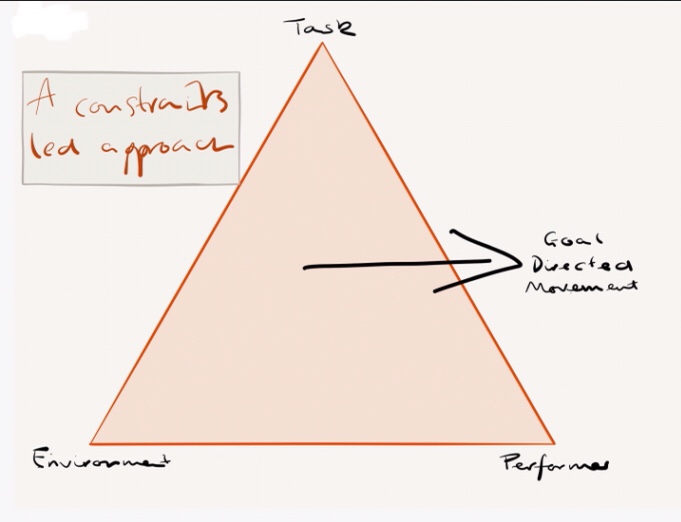
According to ImSporticus (2016) ’A constraints led approach is a teaching/coaching method based on the principles of non linear pedagogy,’ and constraints can be manipulated into three categories; task, performer and environment.
Performer constraints
These are different from participant to participant. They can be physical such as somatotype, weight, height, fitness levels, muscle type or genetic make-up. For example, if a participant is considerably taller than the other participants they may be given a special constraint. If they was playing basketball they may only be allowed in the middle of the court therefore not affecting the points scoring system between the two teams which will then make it a fair game. However, this may hinder that individual as they may not be involved in the game leading to a lack or learning and progress also they will become disinterested easily making the constraint ineffective. On the other hand, this may workout well as the significantly taller participant may be only allowed in the middle of the court but as a floater and can influence the play for both teams. This will therefore benefit the game and the individual as they will still be involved and will aid their development too.
Task constraints
Task constraints are rules, equipment, playing areas, goals, players and therefore the information that is presented by them. For example the use of modified equipment such as a smaller goal for those who may have a higher ability level in football or a wider bat for those who have a lower ability level in cricket/rounders. Changing these task constraints can allow the participants the potential to learn optimal movement patterns , whether this be from making the task easier or harder. However, if the constraint for the participants doesn’t work out, for example, the smaller goal in football as the opposition have realised they can just stand in front of the net and therefore blocking it off this wont benefit them as it will hinder their development.
Environmental constraints
Environmental constraints are things like the surface of play, light, noise, temperature or altitude. For example, the playing surface may be changed to make it harder or easier for the participants to play on. For example, in football to make the game easier the game could be played on a pristine pitch with no mud and no other ailments to hinder the way it plays. However, to make it harder the participants may play on a really muddy and wet pitch which will make the ball harder to pass along the floor and run on therefore meaning a different style of football will need to be played which will benefit the player as it will test their ability levels in tougher conditions. However, this may hinder the players development as they may struggle on the muddy pitch therefore losing confidence in themselves as a player leading to drop off in form and a potential to cause more drop outs.
Renshaw, I., Davids, K., Newcombe, D., & Roberts, W. (2019). The constraints-led approach: Principles for sports coaching and practice design. Routledge.
Renshaw, I., Davids, K., & Savelsbergh, G. J. (Eds.). (2010). Motor learning in practice: A constraints-led approach. Routledge.
A coaching philosophy is unique and it is a guide to the coach’s behaviours and decisions. (Collins, Barber, Moore & Laws, 2011) It should reflect them as a coach and how they will coach their participants. The philosophy should change over time dependant upon your participants. (Parkin, 2009) A good philosophy is key to becoming a successful coach and the use of their sporting experience. Martens (2004) stated that there are three central elements to a coaching philosophy. He believed that relative roles of winning, development and fun should be the main elements to a coaching philosophy. This shows a balance between winning, developing and fun as he feels like a balance between the three can make you a good coach and make your session cater for many participants age, ability and level. Furthermore, Vealey (2005) proposed which three elements are within a coaching philosophy. Optimal performance, optimal development and optimal experience are what he believes should be in a coaching philosophy. This could be true however if he is coaching young children is should be more about the fun side of the session as the aim should be to get them engaged and less focus on winning. Identified themes were integrated into an existing framework. ‘These themes related to immediate enjoyment’ showing the importance of fun in a session and how it can be added to by using a theme. (Vierimaa, Turnnidge, Burner & Cote, 2017)
The age of my coaching group is 16-18 year old college girls who are on the college football team and are at a club level playing on a regular basis for a team on the weekend.
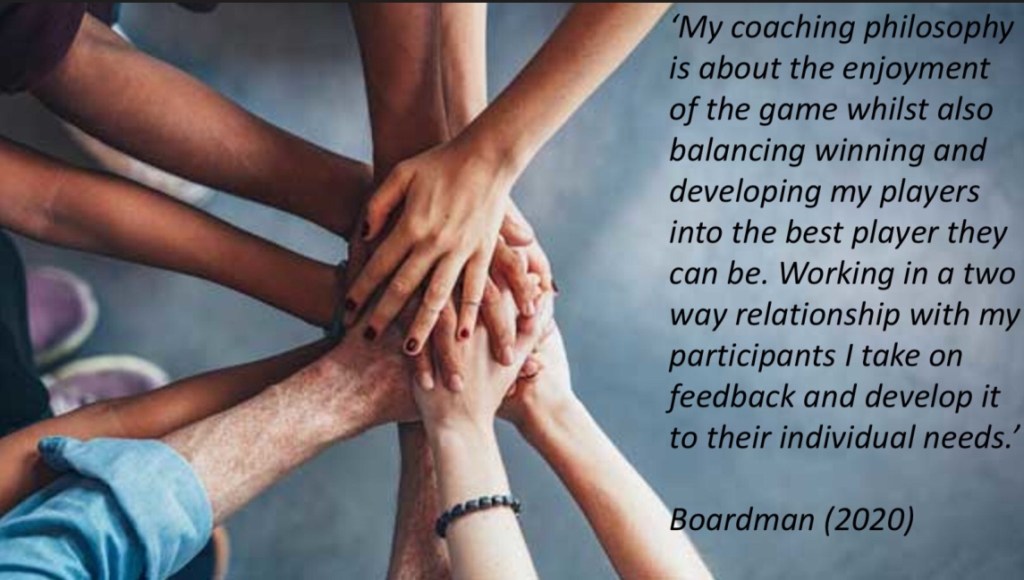
I believe my coaching philosophy should induce enjoyment as if your participants aren’t enjoying the sessions then that will lead to a lot of drop outs as they might lose interest quite quickly, so enjoyment is key to maintaining participation. Furthermore, a good coach should be able to balance winning and developing their players to the best of their ability as when you win it gives a good feeling towards the team, however if a certain player doesn’t play much this could hinder their development as they have hardly played a match so as a coach you must find a way to balance winning over the play time of all your players therefore you will help all the players develop the best they can. Having a two way relationship is important with your participants is very important as I believe that the coach should take the lead and control on a regular basis. However, the coach should also be able to receive feedback from their participants to see how they may want a certain session to run or drills to help them as a team and as an individual ad by doing this it can help the players individual needs.
Reference list
Collins, K., Barber, H., Moore, K., & Laws, A. (2011) The first step: Assessing the coaching philosophies and pre-service coaches. ICHPER-SD journal of research, 6(2), 21-29
Martens, R. (2004). Successful coaching Human Kinetics. Champaign, Ill.
Vealey, R. S. (2005). Coaching for the inner edge. Fitness Information Technology.
Vierimaa, M., Turnnidge, J., Bruner, M., & Côté, J. (2017). Just for the fun of it: Coaches’ perceptions of an exemplary community youth sport program. Physical Education and Sport Pedagogy, 22(6), 603-617.
A warm up is ‘considered to be essential for optimum performance.’ (Bishop, 2003) One of the main purpose of warm up is injury prevention practice. (Soligard et al, 2010) as this will get the muscles warm therefore reducing the chance of any injury. Fradkin, Zazryn & Souissi, (2016) stated that a warm up was shown to improve performance in 79% of people examined. This is showing how beneficial a warm up is in the lead up to a performance as if you don’t warm up properly you have a higher chance of injury therefore leading to a poor performance as you may not be mentally warm up for your activity.
According to Frikha, Chaari, Mezghanni & Soussi (2016) a warm up should last between 5 and 15 minutes as this is considered a fundamental part of the training process and it warms the muscles up which will reduce the chance of injury.
A warm up works the muscles and therefore increases the bloody supply. (Alanazi, 2016) this shows that increasing the bloody supply will benefit you as your muscles will be ready for the main activity in the session. Furthermore, according to Ajidahun & Phillips (2013) ‘Stretching is usually considered in a warm up.’ This shows the importance of stretching in a warm up as if you don’t stretch then you will have a higher chance of pulling a muscle. In addition to this Perrier, Pavol & Hoffmann (2011) state that a warm up should include static or dynamic stretches, therefore again showing how important stretching is to complete a proper warm up and so your muscles are stiff for the main activity. On the other hand ‘Studies on both children and adults have established that pre- event static stretching inhibits performance by decreasing power, strength and high-speed production.’ (Gelen, 2011) so this is showing that static stretches before performance can minimise your chance of performing at your highest level as can decrease power, strength and high speed. Continuously, ‘Dynamic stretching has gained popularity, due to a number of studies showing an increase in high intensity performance compared to static stretch modalities.’(Fletcher, 2010) This is showing the impact dynamic stretching has over static stretching and dynamic stretches get your body and muscles moving and improve flexibly better than static stretches.
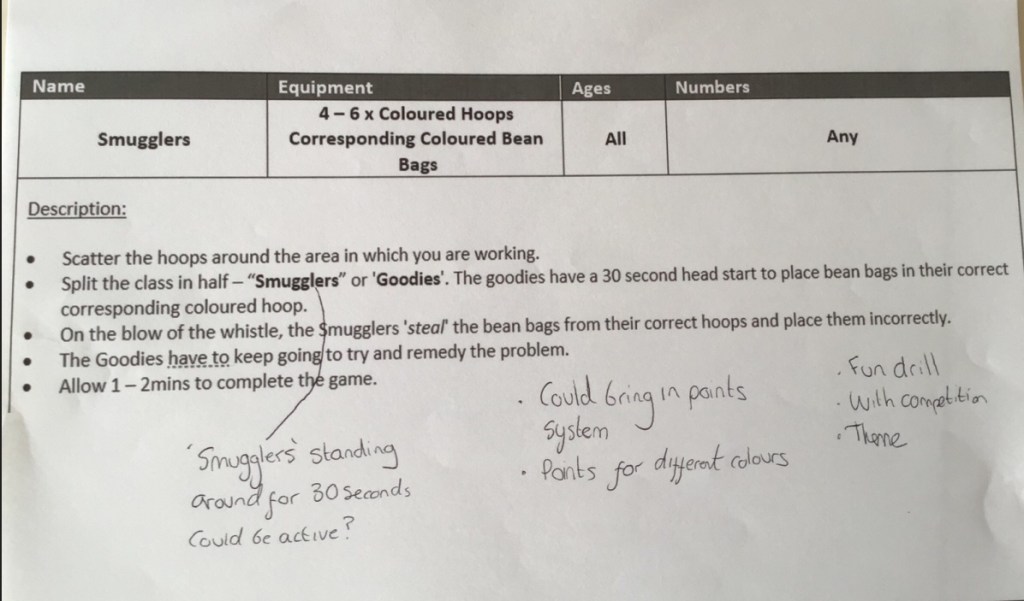
Here is an example of a mini warm up session called smugglers. The session is aimed at all ages and can involve any number of participants. I have done small annotations on the image to highlight what is good and what is an area for improvement for the session.
Positives:
The drill is suitable for any age
Element of competition involved
Fun, therefore will engage all participants
Areas for improvement:
The ‘Smugglers’ are standing around for 30 seconds which may lead to them becoming bored
Could they be active?
A points system could be included to make the competition levels higher
Each colour could be a different point
Here is an example of one of my mini warm up sessions called foxes and rabbits. The session is aimed at all ages and can be adapted depending upon the age group. Furthermore, it can involve any numbers of participants. I have done small annotations on the image to highlight what is good about the session and what the areas for improvement are. Also this session was carried out and feedback has been giving via a small questionnaire.
Positives:
Easy setup due to small amount of equipment
Inclusive for all participants
Good enjoyable pulse raiser
The progression was sports specific
Diagrams to aid further understanding
Areas for improvement:
Look for small progressions within first part of warm up
The main progression could this be progressed again by including passing?
It was the same drill, however only footballs was added could this be varied?
This was a quick evaluation questionnaire to gain instant feedback upon the session. This was anonymous therefore any feedback could have been given. However, the questionnaire could have been better as there could have been more open ended questions to gain even more feedback to then pinpoint what was good and what areas needed improvement.
Reference list
Alanazi, H. M. (2016). Role of Warming-up in Promoting Athletes Health and Skills. International Journal of Scientific and Research Publications, 1, 156-160
Ajidahun, A. T., & Phillips, J. (2013). Content of a warm up programme for instrumental musicians: A Delphi study. Sports Medicine Journal/Medicina Sportivâ, 9(2).
Bishop, D. (2003). Warm up II. Sports medicine, 33(7), 483-498.
Fletcher, I. M. (2010). The effect of different dynamic stretch velocities on jump performance. European journal of applied physiology, 109(3), 491-498.
Fradkin, A. J., Zazryn, T. R., & Smoliga, J. M. (2010). Effects of warming-up on physical performance: a systematic review with meta-analysis. The Journal of Strength & Conditioning Research, 24(1), 140-148.
Frikha, M., Chaâri, N., Mezghanni, N., & Souissi, N. (2016). Influence of warm-up duration and recovery interval prior to exercise on anaerobic performance. Biology of Sport, 33(4), 361.
Gelen, E. (2011). ACUTE EFFECTS OF DIFFERENT WARM-UP METHODS ON JUMP PERFORMANCE IN CHILDREN. Biology of Sport, 28(2).
Perrier, E. T., Pavol, M. J., & Hoffman, M. A. (2011). The acute effects of a warm-up including static or dynamic stretching on countermovement jump height, reaction time, and flexibility. The Journal of Strength & Conditioning Research, 25(7), 1925-1931.
Soligard, T., Nilstad, A., Steffen, K., Myklebust, G., Holme, I., Dvorak, J., … & Andersen, T. E. (2010). Compliance with a comprehensive warm-up programme to prevent injuries in youth football. British journal of sports medicine, 44(11), 787-793.
According to Uk Coaching (2020) UK coaching week was held from the 14th- 20th September. It is an ’awareness campaign, which empowers athletes, coaches and the public to celebrate great coaching.’
Coaches are important as they are ’influential at creating positivity.’ (Collins, Barber, Moore and Laws, 2011) this shows that they are important as they will bring positivity to the session therefore making all participants involved excited and engaged for the session. Furthermore, according to Piper (2014) coaches are a benefit of their continuing involvement in sport. Implying that coaches are important as they’re part of the reason a participant will drop out of stay playing a certain sport. This could be whether they feel they’re progressing under a coach, they do not get along with a certain coach or if the participant doesn’t enjoy the sessions. Continuously, this is why coaches are so important as they must cater for all participants to maximise their sessions and keep everyone happy and enjoying the session. Another reason why coaches are extremely important to the community is the fact that they are volunteers and they give up their free time to coach various people in the community. A sports survey was undertaken and the results showed that ‘81% of coaches was unpaid.’ (Robinson & Gill, 2014) therefore showing how vital most coaches are as they do it for free which then allows the club to take the majority of the money and then use it to build up the club and or the community.
A coaching pledge is something a coach believes in. This may be part of their coaching style of how they make their coaching unique. It can also be to help other less experienced coaches gain vital knowledge when they want to become better. According to Women learning in education (2020) ‘coaching has the power to increase confidence, unlock potential and build resilience. It is flexible.’ This can show how powerful a coaching pledge can be the less experienced coaches during a difficult period. My coaching pledge is to help inexperienced coaches during this pandemic to give them valuable skills, as seen in he video, as I can give them ideas on how to make their session as safe as possible and propose new socially distanced activities.
Reference list
Collins, K., Barber, H., Moore, K., & Laws, A. (2011). The first step: Assessing the coaching philosophies of pre-service coaches. ICHPER-SD Journal do research, 6(2), 21-29
Piper, H. (Ed.). (2014). Touch in sports coaching and physical education: Fear, risk and moral panic. Routledge.
Robinson, P. E., & Gill, A. (2014). Foundations of sports coaching. Routledge.
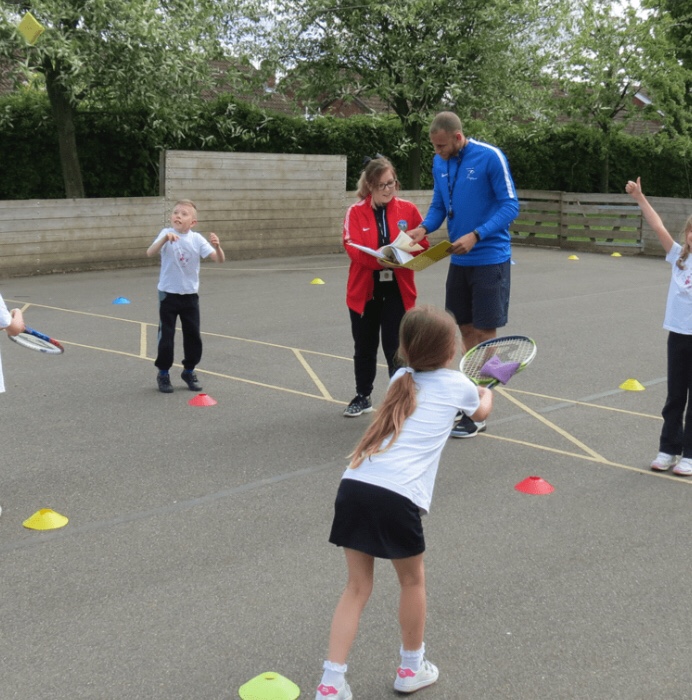
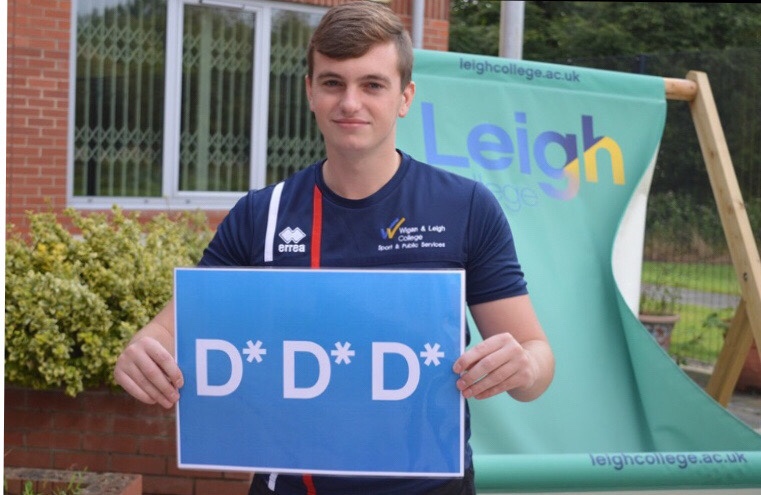
Hello and welcome to my blog post, my name is Rob Boardman and I am going to be sharing my ideas on coaching and reflecting on my coaching journey. My coaching background is that I have had experience with coaching in primary schools and secondary schools, delivering fun sessions, which aid the basic fundamental skills, A,B and C’s, and also delivered coach education workshops to students.
I enjoy coaching because it gives me a chance to get across my ideas and teaching young children sports that they enjoy doing. Furthermore, I enjoy the challenges that come alongside with coaching young children as they are all different therefore new challenges come everyday and having to think of ways to overcome these difficulties is something I enjoy doing.
Strengths
Communication- I feel I am good at breaking down activities to it’s simplest form meaning everyone can understand the task
Session planning- I provide fun themed games to aid development of the basic A,B,C’s to young participants
Time management- I always plan the session to last the duration it is meant to do and it doesn’t run over or finish too early.
Areas for development
Positive attitude- As I sometimes feel like I need to be more positive if a drill isn’t planning out the way it should be or if the participants aren’t performing it as well as perceived
Patience- This is because if someone goes wrong I find it frustrating, where as I should understand and try to find ways to improve the session to make it suit the participants
Aspirations for after the course
After I have finish my second year of the foundation degree I will continue to UCLAN and do my top up year to complete the full degree. Following on from this I will aim to do my teacher training and my PGCE and to then become a fully qualified teacher. During this year and my final study year I will be looking at work placements in schools, this may be difficult this year due to the current pandemic as schools may not allow external people to enter, as I feel this will be my knowledge as a coach and then give me more experience of what a teaching role will look like.
COVID 19 is a new illness that can effect your lungs and airway, it can lead to pneumonia. (NHS,2020) The signs of COVID 19 include; a high temperature, a new continuous cough and the loss of smell. (NHS, 2020) on the 15th September 2020 there was 3103 cases in the UK alone and 374,228 cases overall. (Gov.UK, 2020)
There was some key dates associated with COVID 19:
21st December 2019 a unknown pneumonia liked disease became present
11th January the first recorded COVID 10 death
25th January travel restrictions was put into place
13th March Sports events started to be cancelled
20th March complete lockdown
17th June the Premier league restarted
Coronavirus has had a huge impact on school sports and PE, community cubs and professional sports club. This is because they had to stop for a lengthy period of time and also the many restrictions that all the clubs must follow.
School sport and PE have been effected as the sports they can do are limited as they must try to do sports that require as little contact as possible to maintain social distancing. They may have to create a bubble system within the school therefore meaning the session will end up mixed ability therefore the session being not beneficial for anyone. Furthermore, the session timings are effected as changing times take longer therefore the actual session doesn’t last as long therefore the participants will miss out on valuable learning.
Community clubs have been effected as they have to get every member to take part in the track and trace system therefore if one player from a certain team tests positive any team that have been in contact with that one person can’t train or play matches for two weeks therefore having an impact on matches fitness and a potential to mis out on a key training session. Money has also been a huge factor towards community clubs as they have not been collecting subs through lockdown meaning some clubs may not be able to afford to stay open due to lack of funds, this means a lot of players may drop out of the sport.
Professional sports have been impact by COVID as they have to test each player on a regular basis and if any player has it they have to go into self isolation for ten days meaning they miss out and therefore lose match sharpness. Teams also have a bubble system set up meaning they may not be able to see family members as they are at risk of getting the virus from them, this could have a mental impact on the player as their mind might not be fully focussed.
How has it impacted me?
COVID has had a huge impact on my coaching: (Negative)
Lack of coaching time- as I have missed over 24 hours of valuable coaching experience
Lack of opportunity to now coach in a school which is needed to support my progression into teaching
Many environments won’t take on for work experience as they don’t want to risk more COVID cases
Positive impacts COVID has had:
Online workshops have become available as free training opportunities to support my CPD
Time to plan sessions over lockdown
Can reflect on previous session and see how to improve
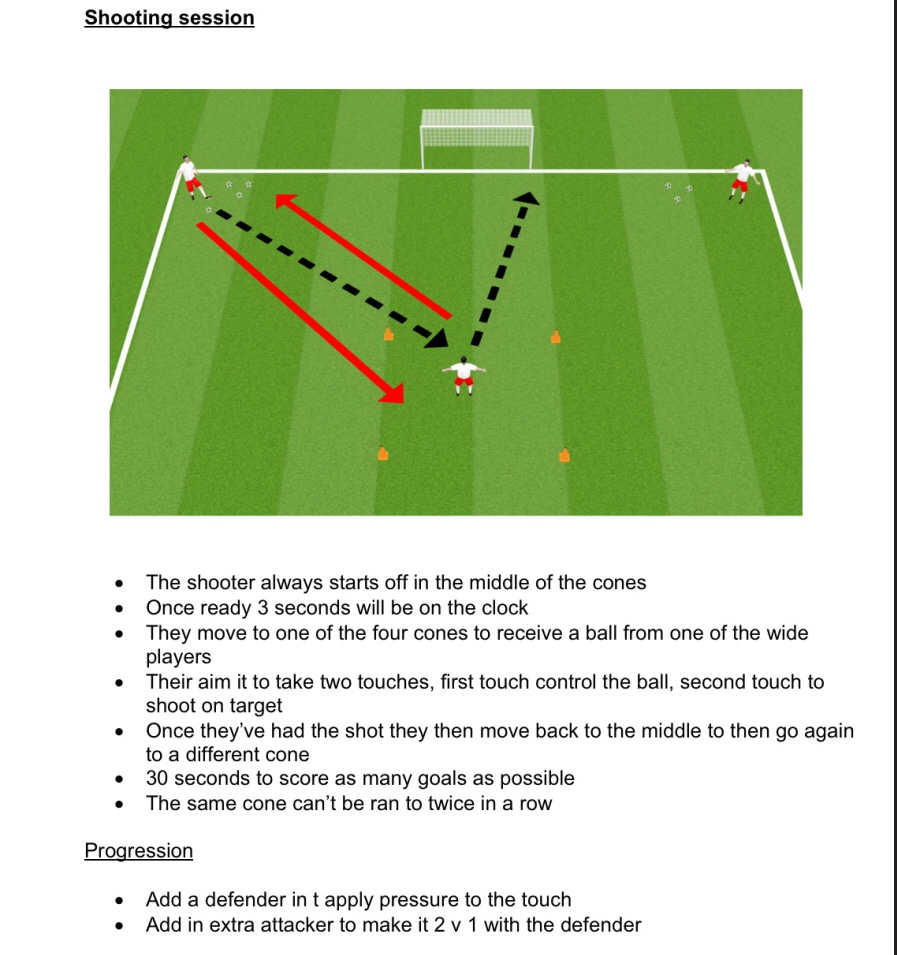
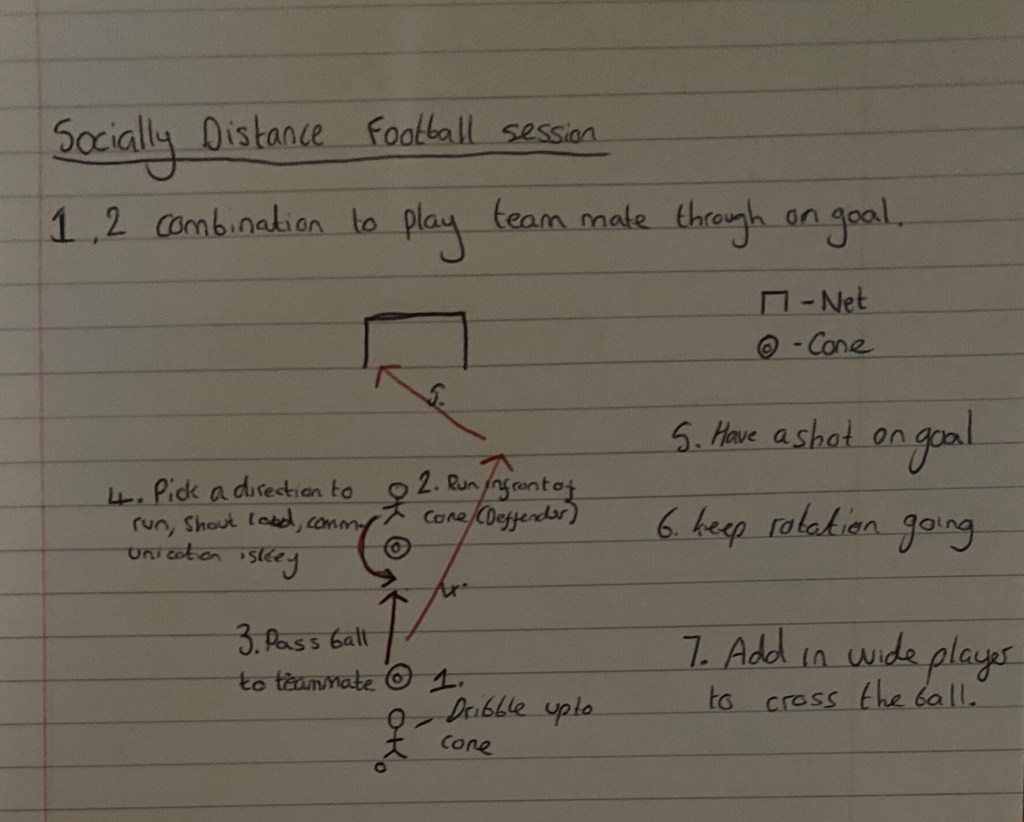
Here is an example of a socially distanced football drilled that I have carried out throughout my coaching practice. This activity is socially safe as there is no contact between players as they are all at least 2M apart. Only one ball will be used and no one will handle the ball. Furthermore, each player will have hand sanitised prior to the drill and the footballs will have been wiped down. This type of session, although not ideal, can still improve the teams play as it is working on balls being crossed in from the wides areas and also focussing on getting your shots on target and precision over power.
Reference list
NHS (2020). Coronavirus (COVID-19) Retrieved from 23/09/20, from www.nhs.uk
GOV.UK (2020). Coronavirus (COVID-19) Retrieved from 23/09/20, from www.gov.uk







 Reflective Coach