A coaching philosophy is unique and it is a guide to the coach’s behaviours and decisions. (Collins, Barber, Moore & Laws, 2011) It should reflect them as a coach and how they will coach their participants. The philosophy should change over time dependant upon your participants. (Parkin, 2009) A good philosophy is key to becoming a successful coach and the use of their sporting experience. Martens (2004) stated that there are three central elements to a coaching philosophy. He believed that relative roles of winning, development and fun should be the main elements to a coaching philosophy. This shows a balance between winning, developing and fun as he feels like a balance between the three can make you a good coach and make your session cater for many participants age, ability and level. Furthermore, Vealey (2005) proposed which three elements are within a coaching philosophy. Optimal performance, optimal development and optimal experience are what he believes should be in a coaching philosophy. This could be true however if he is coaching young children is should be more about the fun side of the session as the aim should be to get them engaged and less focus on winning. Identified themes were integrated into an existing framework. ‘These themes related to immediate enjoyment’ showing the importance of fun in a session and how it can be added to by using a theme. (Vierimaa, Turnnidge, Burner & Cote, 2017)
The age of my coaching group is 16-18 year old college girls who are on the college football team and are at a club level playing on a regular basis for a team on the weekend.
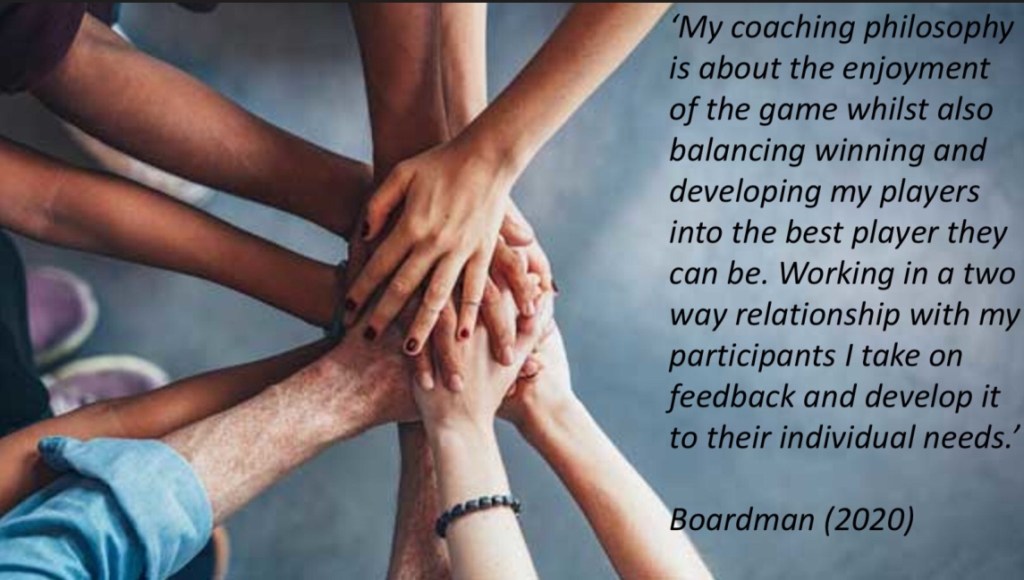
I believe my coaching philosophy should induce enjoyment as if your participants aren’t enjoying the sessions then that will lead to a lot of drop outs as they might lose interest quite quickly, so enjoyment is key to maintaining participation. Furthermore, a good coach should be able to balance winning and developing their players to the best of their ability as when you win it gives a good feeling towards the team, however if a certain player doesn’t play much this could hinder their development as they have hardly played a match so as a coach you must find a way to balance winning over the play time of all your players therefore you will help all the players develop the best they can. Having a two way relationship is important with your participants is very important as I believe that the coach should take the lead and control on a regular basis. However, the coach should also be able to receive feedback from their participants to see how they may want a certain session to run or drills to help them as a team and as an individual ad by doing this it can help the players individual needs.
Reference list
Collins, K., Barber, H., Moore, K., & Laws, A. (2011) The first step: Assessing the coaching philosophies and pre-service coaches. ICHPER-SD journal of research, 6(2), 21-29
Martens, R. (2004). Successful coaching Human Kinetics. Champaign, Ill.
Parkin, D. , Coaching Philosophy, retrieved March 20, 2009 from http://www.afl.com.au/news/newsarticle/tabid/208/newsid/4753/default.aspx, 2003.
Vealey, R. S. (2005). Coaching for the inner edge. Fitness Information Technology.
Vierimaa, M., Turnnidge, J., Bruner, M., & Côté, J. (2017). Just for the fun of it: Coaches’ perceptions of an exemplary community youth sport program. Physical Education and Sport Pedagogy, 22(6), 603-617.


