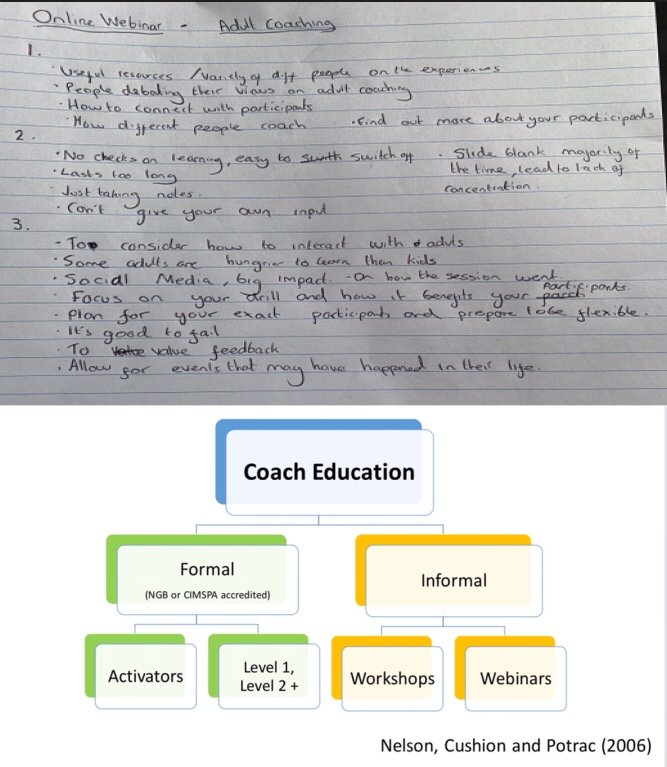
Coach eduction is ‘a key vehicle for raising the standard of coaching practice.’ (Nelson, Cushion & Potrac, 2013) Coach education can be split up into two main categories, formal and informal practices.
Formal coach education
Formal coach education is ran by national governing bodies (NGB) and are split into activator courses and level 1 and level 2+ qualifications. Furthermore, a formal coach education practice is compulsory to attend all parts of the practice and the assessment is based against a set number of minimum competencies. At the end of the practice, if passed, each clients will receive a certificate saying that they have passed and completed the course.
Informal Coach education
Informal coach education is ran outside of the NGB network therefore can be ran by anyone. They can be split into workshops and webinars. The informal practice is self directed and knowledge based and at the end of the practice there can be a knowledge assessment. There is also a certification process to say you have competed the coach education practice.
Below is some feedback from a recent online webinar I took part in for coaching adults. It highlighted what is good about an online webinar, what issues you may face when participating in an online webinar and the knowledge I have gained from it.
Analysing my Coach Education experiences
My various Coach Education practices-
- Online Webinar (Adult Coaching)
- Equality and Diversity (Informal CE workshop)
- FA introduction to Talent ID Level (Informal CE workshop)
- Tennis Activators (Formal CE)
- Basketball activators (Formal CE)
- Baseball activators (Formal CE)
- Athletics activators (Formal CE)
- The FA player award (Informal CE workshop)
- NPLQ (National Pool Lifeguard Qualification) (Formal CE)
Below are some examples of certificates and topic booklets received from these Coach Education practices that I have gained.

Within each variant of a Coach Education practice I feel I prefer the formal Coach Eduction practices. This is due to the practical element being involved within the practices as these get me more engaged and therefore are more likely to benefit me greater as I will benefit more from this. For example, doing the equality and diversity workshop (Informal CE) I feel like this was very beneficial as it opened my eyes to various scenarios that I may not have realised can happen within coaching. However, the fact it was online and just reading and answering questions made me disengage with the course therefore the way I did the course may not have been as beneficial as if it had some practical elements. On the other hand, when I completed the Basketball activators (Formal CE) I feel like this benefitted me in multiple ways as I can use the drills that we was shown as use them in many other sports that I coach myself. The resource booklet we took away can be used in the future in our own coaching as we can use these sessions whenever we like and tailor it to our own coaching and finally the fact that we got to coach a sport that we may not necessarily do on a regular basis can benefit us as we now have a wider range of knowledge in that sport.
Types of CE I want to access in the future
- Level 1/2 in Football coaching
- A number of new a different activator courses
- More online webinars about inclusive coaching/ how to make your coaching better
- FA level 2 Talent ID
- More FA equality and diversity badges
I would like to complete as many more Coach Education practices as I can as I feel this will enhance my knowledge upon various different platforms within coaching and it will aid boost my CV when applying for a job.
Reference list
Nelson, L., Cushion, C., & Potrac, P. (2013). Enhancing the provision of coach education: The recommendations of UK coaching practitioners. Physical Education and Sport Pedagogy, 18(2), 204-218.
Nelson, L. J., Cushion, C. J., & Potrac, P. (2006). Formal, nonformal and informal coach learning: A holistic conceptualisation. International Journal of Sports Science & Coaching, 1(3), 247-259.


