Who would’ve though the ‘Jumpers for goalposts’ saying would come true in the sense of at home PE. This is due to the current COVID 19 situation and the schools being closed and students having to use their own resources to keep active just like when you are on the playground and your school jumper replaces the goalposts.
At home or remote PE is currently taking place due to the current government situation regarding the closure of schools, colleges and universities across the country. The current COVID 19 situation means that PE can not take place in the way it usually would whether it being a full class game of rounders outside or a handball session in the sports hall. This has changed the way PE is done massively with some students potentially missing out on valuable exercise or their only physical exercise that week. PE sessions have changed to either student creating their own at home PE resource or they are participating in a previously designed remote PE resource. I feel like I am in a position to help schools, this is because I may have more knowledge n that specific area than the standard primary school teacher. Furthermore, they also have a lot of other work to be doing therefore PE may be the last thing on their mind. On the other hand, this will benefit as I can create at home resources to provide to schools to use in their lessons. This will benefit me as it will help the to gain experience and valid feedback upon sessions I plan.
Issues with at home PE
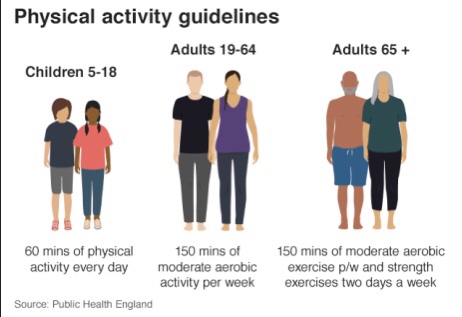
There are many issues with at home PE that can effect a student in many ways. Whether this be a decline in their fitness or a decline in their mental health as a results of a lack of exercise. As stated by Therrien (2018) there is a guide to the duration of physical activity people should do per week depending upon their age. The image below shows the physical activity guidelines for the different ages. As shown by the image children aged between 5-18 should have at least 60 minutes of exercise everyday. With the home PE the children wont be able to fulfil this guideline which may lead to an increase in child obesity and also it may lead to a high drop out rate due to a loss of interest during this period
Furthermore, many students may find at home PE boring or disengaging as they’d much rather be doing other thing than doing their PE session at home. This may be due to a lack of concentration as different ages of children can only concrete for so long. According to Brain Balance (2020) the table below shows the average attention span for children up to 16 years old.
Average attention spans work out like this:
- 2 years old: four to six minutes
- 4 years old: eight to 12 minutes
- 6 years old: 12 to 18 minutes
- 8 years old: 16 to 24 minutes
- 10 years old: 20 to 30 minutes
- 12 years old: 24 to 36 minutes
- 14 years old: 28 to 42 minutes
- 16 years old: 32 to 48 minutes
Continuously, these figures show that it can be hard to concentrate for lengthy periods of time this is why PE can be an escapee for some students as it will clear their mind of anything that can be bothering them and they are just sat in a chair listening to a teacher in a classroom. As a results of this online PE can be a negative as they won’t get that time to use up their energy they are just sitting in front of their computer and therefore are more likely to lose their focus quicker which may potentially make the session irrelevant.
What does good practice look like?
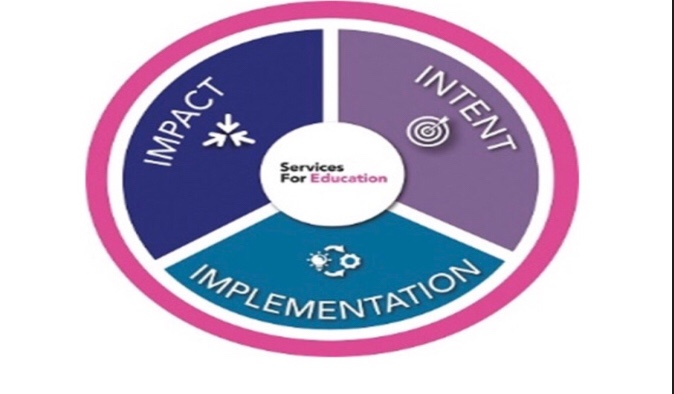
There are three focus points to work on when focussing on what good practice looks like, intent, implement and impact.
Intent- By identifying priorities, focusing on learning and the students you have in front of you and catering it to their specific needs. Consider, why are PE lessons so important? What content you want to deliver? Furthermore, focus on who you are teaching as each participant is unique.
Implementation- Online lessons can sill be very meaningful and have a positive impact on students learning.
Research from the Education Endowment Foundation tells us:
- Teaching quality is more important than how the lesson is delivered
- Peer interaction can provide motivation and provide better learning outcomes
- Ensuring access to the technology is key, especially for the disadvantaged pupils
Impact- The amount of content out there suggests we don’t have to reinvent the wheel to make an impact. This shows that at home PE can have the same benefits as in school PE just because they’re at home on their computer doesn’t mean they can’t have as much fun or learn as much as they would in their practical session.
(Keens, L, 2020)
My at home PE resource
This is an example of an at home PE resource.
The key areas to think about when creating the resource:
- A theme (does it suit the participants)
- Engaging
- Enjoyable activities
- Beneficial activities
- Health and safety
- Accessibility to equipment/resources needed
- A variety of exercises, to suit mixed abilities
- Links/diagrams of how to perform exercises correctly and safely
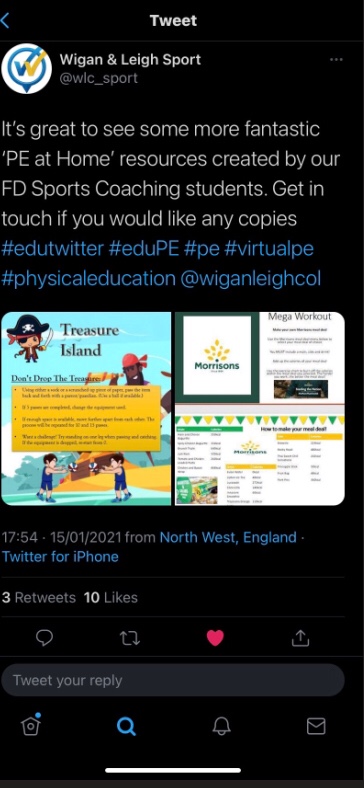
Below is my at home PE resource. The theme suits the intended audience. Engaging activities are included as it is building a meal deal and then burning off the chosen calories. Health and safety is considered when planning the resource as there are links on how to perform each exercise effectively and safely. Each activity can suit a variety of abilities and can also benefit the individual participating.
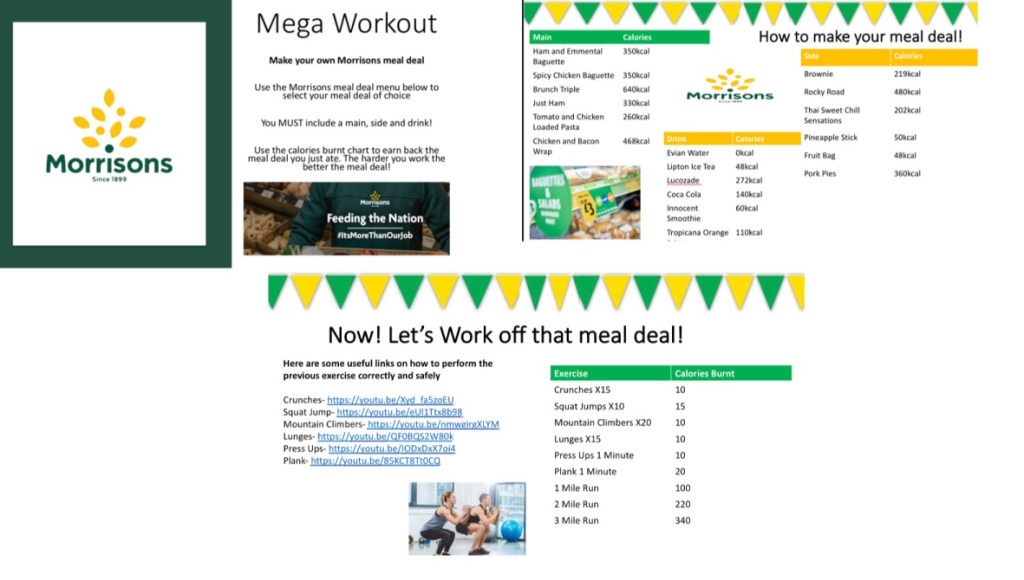
As seen below the at home PE session has been uploaded to the college Twitter account for anyone to use them or participate in them to gain their fitness over lockdown and can be very useful for any online PE sessions. From this experience I learnt that creating an online resource can be extremely difficult, this is because you need to consider, will they have the space to do this activity?, will they have the equipment to do this activity? or do they need assistance when doing the activity? You have to make the activity as inclusive for everyone as possible and understand every child has a different circumstance to their learning environment.
Feedback
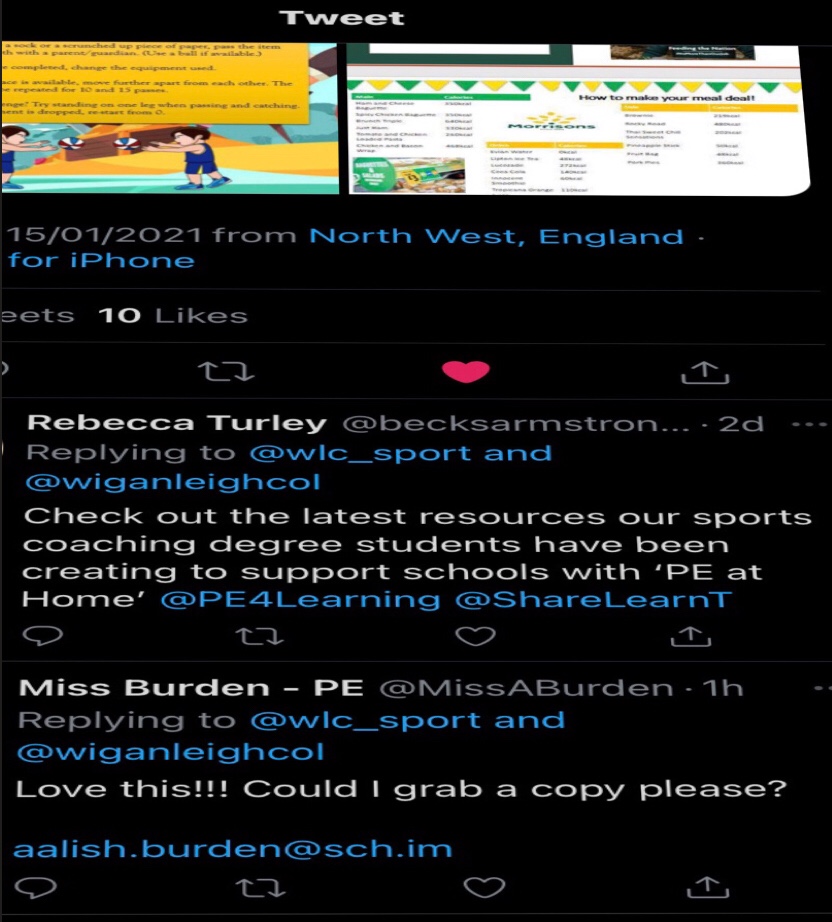
Comments have been made on the post asking can they have a copy of the resources for their students to work on whether this be an example for them to create their own or the students are going to be participating in the at home PE session. From this I have gained some valuable employability skills, such as my planing and delivery of sessions and how different it is from remote sessions to face to face sessions. The planning for remote PE has proved to be more of a challenge as you have to think of the type of activity in more detail as considering peoples working environments can prove to be a challenge as they may not be able to to certain activities you have planned. Furthermore, using various different ICT resources enhances my employability as using apps such as Microsoft word and PowerPoint are widely used across the teaching base now and knowing how to use them gives you an advantage over other people who struggle with ICT resources.
Reference list
Brain Balance (2020) Normal Attention Span expectations by age. Retrieved February 24, 2020, from https://blog.brainbalancecenters.com/normal-attention-span-expectations-by-age
Keens, L (2020) Teaching PE online. Retrieved, 2020, from https://medium.com/age-of-awareness/teaching-pe-online-75dd586f2340
Therrien, A. (2018) Lack of exercise puts one in four people at risk, who says. Retrieved September 4, 2018, from https://www.bbc.co.uk/news/health-45408017


