A warm up is ‘considered to be essential for optimum performance.’ (Bishop, 2003) One of the main purpose of warm up is injury prevention practice. (Soligard et al, 2010) as this will get the muscles warm therefore reducing the chance of any injury. Fradkin, Zazryn & Souissi, (2016) stated that a warm up was shown to improve performance in 79% of people examined. This is showing how beneficial a warm up is in the lead up to a performance as if you don’t warm up properly you have a higher chance of injury therefore leading to a poor performance as you may not be mentally warm up for your activity.
According to Frikha, Chaari, Mezghanni & Soussi (2016) a warm up should last between 5 and 15 minutes as this is considered a fundamental part of the training process and it warms the muscles up which will reduce the chance of injury.
A warm up works the muscles and therefore increases the bloody supply. (Alanazi, 2016) this shows that increasing the bloody supply will benefit you as your muscles will be ready for the main activity in the session. Furthermore, according to Ajidahun & Phillips (2013) ‘Stretching is usually considered in a warm up.’ This shows the importance of stretching in a warm up as if you don’t stretch then you will have a higher chance of pulling a muscle. In addition to this Perrier, Pavol & Hoffmann (2011) state that a warm up should include static or dynamic stretches, therefore again showing how important stretching is to complete a proper warm up and so your muscles are stiff for the main activity. On the other hand ‘Studies on both children and adults have established that pre- event static stretching inhibits performance by decreasing power, strength and high-speed production.’ (Gelen, 2011) so this is showing that static stretches before performance can minimise your chance of performing at your highest level as can decrease power, strength and high speed. Continuously, ‘Dynamic stretching has gained popularity, due to a number of studies showing an increase in high intensity performance compared to static stretch modalities.’(Fletcher, 2010) This is showing the impact dynamic stretching has over static stretching and dynamic stretches get your body and muscles moving and improve flexibly better than static stretches.
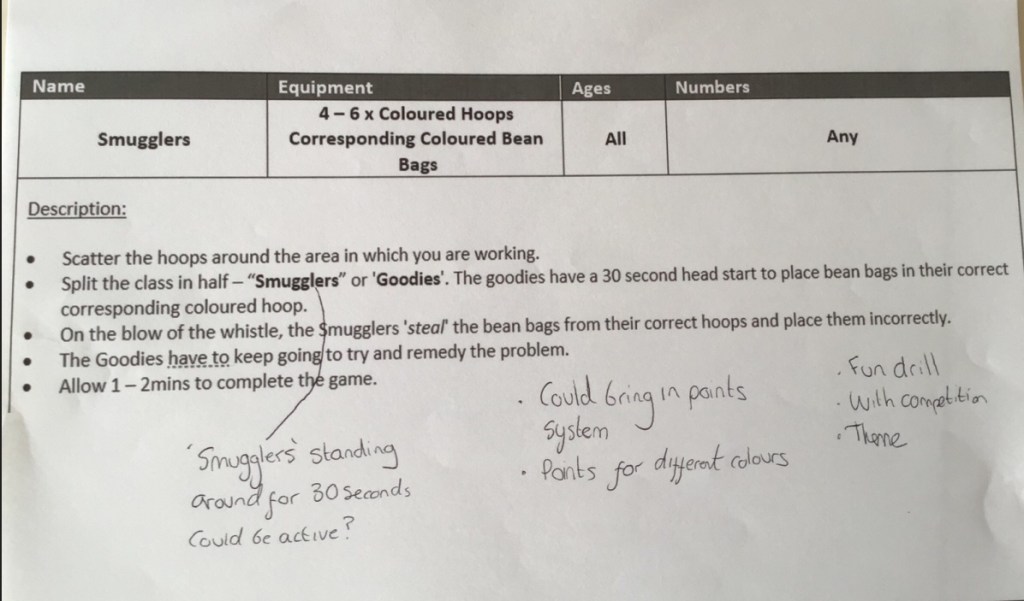
Here is an example of a mini warm up session called smugglers. The session is aimed at all ages and can involve any number of participants. I have done small annotations on the image to highlight what is good and what is an area for improvement for the session.
Positives:
- The drill is suitable for any age
- Element of competition involved
- Fun, therefore will engage all participants
Areas for improvement:
- The ‘Smugglers’ are standing around for 30 seconds which may lead to them becoming bored
- Could they be active?
- A points system could be included to make the competition levels higher
- Each colour could be a different point

Here is an example of one of my mini warm up sessions called foxes and rabbits. The session is aimed at all ages and can be adapted depending upon the age group. Furthermore, it can involve any numbers of participants. I have done small annotations on the image to highlight what is good about the session and what the areas for improvement are. Also this session was carried out and feedback has been giving via a small questionnaire.
Positives:
- Easy setup due to small amount of equipment
- Inclusive for all participants
- Good enjoyable pulse raiser
- The progression was sports specific
- Diagrams to aid further understanding
Areas for improvement:
- Look for small progressions within first part of warm up
- The main progression could this be progressed again by including passing?
- It was the same drill, however only footballs was added could this be varied?

This was a quick evaluation questionnaire to gain instant feedback upon the session. This was anonymous therefore any feedback could have been given. However, the questionnaire could have been better as there could have been more open ended questions to gain even more feedback to then pinpoint what was good and what areas needed improvement.
Reference list
Alanazi, H. M. (2016). Role of Warming-up in Promoting Athletes Health and Skills. International Journal of Scientific and Research Publications, 1, 156-160
Ajidahun, A. T., & Phillips, J. (2013). Content of a warm up programme for instrumental musicians: A Delphi study. Sports Medicine Journal/Medicina Sportivâ, 9(2).
Bishop, D. (2003). Warm up II. Sports medicine, 33(7), 483-498.
Fletcher, I. M. (2010). The effect of different dynamic stretch velocities on jump performance. European journal of applied physiology, 109(3), 491-498.
Fradkin, A. J., Zazryn, T. R., & Smoliga, J. M. (2010). Effects of warming-up on physical performance: a systematic review with meta-analysis. The Journal of Strength & Conditioning Research, 24(1), 140-148.
Frikha, M., Chaâri, N., Mezghanni, N., & Souissi, N. (2016). Influence of warm-up duration and recovery interval prior to exercise on anaerobic performance. Biology of Sport, 33(4), 361.
Gelen, E. (2011). ACUTE EFFECTS OF DIFFERENT WARM-UP METHODS ON JUMP PERFORMANCE IN CHILDREN. Biology of Sport, 28(2).
Perrier, E. T., Pavol, M. J., & Hoffman, M. A. (2011). The acute effects of a warm-up including static or dynamic stretching on countermovement jump height, reaction time, and flexibility. The Journal of Strength & Conditioning Research, 25(7), 1925-1931.
Soligard, T., Nilstad, A., Steffen, K., Myklebust, G., Holme, I., Dvorak, J., … & Andersen, T. E. (2010). Compliance with a comprehensive warm-up programme to prevent injuries in youth football. British journal of sports medicine, 44(11), 787-793.

 Reflective Coach